
September 5, 2026
Is Freemasonry a Secret Society?
By Phillip Himes, Past Master
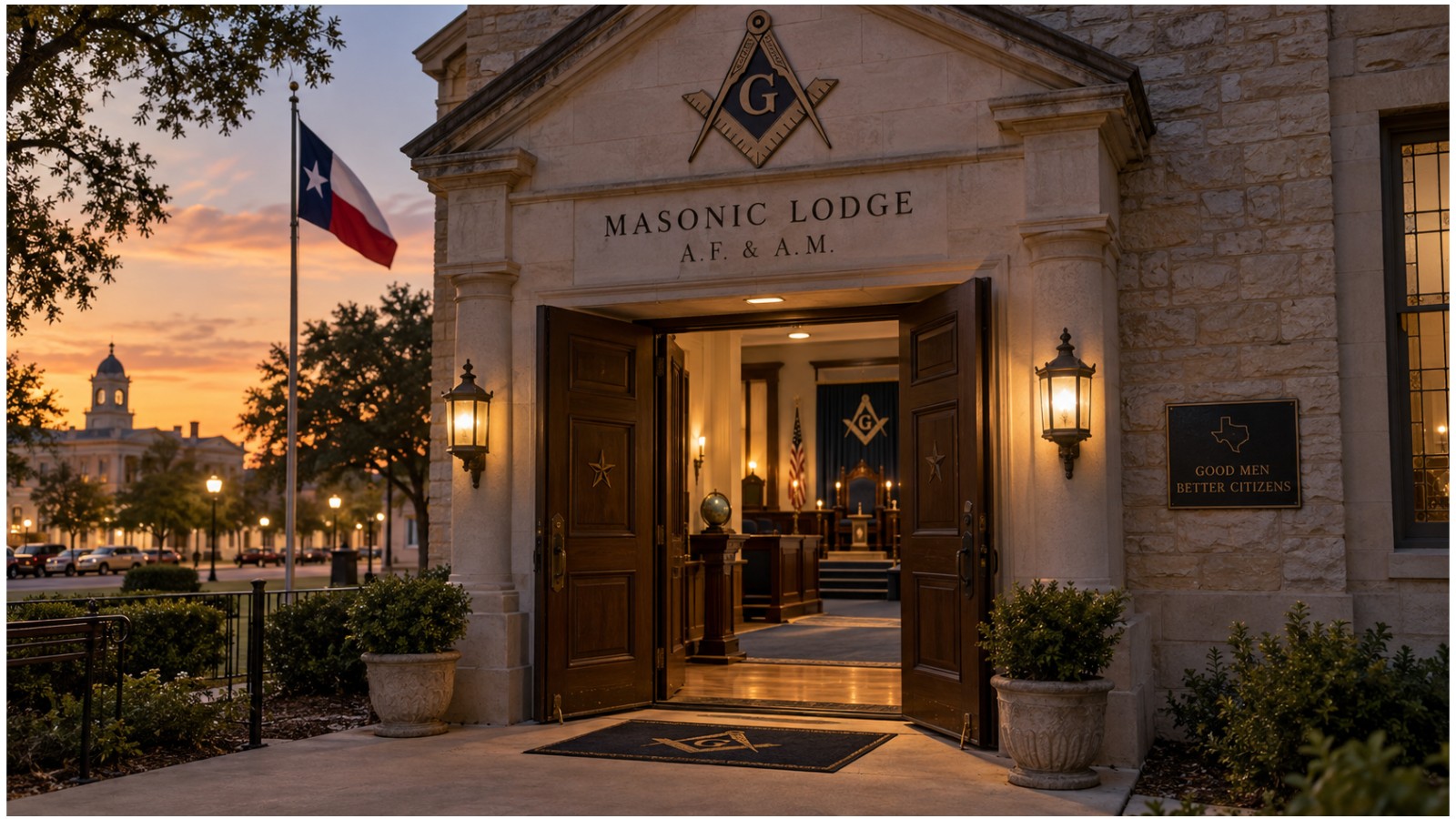
No. Freemasonry is a society with secrets, not a secret society. Our League City lodge explains what is public, what stays private, and exactly why.
No. Freemasonry is not a secret society. It is a society with secrets, which is a different thing. The lodge, its members, its meeting times, and its purpose are all public. What stays private is a short list of traditions: our modes of recognition, the details of our ceremonies, and the ballot.
That is the short answer. It is the question we get asked more than any other, so it is worth going through properly.
What Would Make a Society Secret
A secret society hides three things: that it exists, who belongs to it, and what it does. Freemasonry does none of those.
Our existence is public. The lodge is at 510 E Main Street in League City. Our name is on the sign and the square and compasses are on the building. We have been chartered here since 1911, under the Grand Lodge of Texas, whose constitution and law are published online along with a directory of every lodge in the state. Our meeting nights are at the bottom of this page, and our calendar of events is open to anyone.
Our members are public. Masons wear rings. We put decals on our trucks and the square and compasses on our headstones. The officers of this lodge are listed by name and photograph on our About page. You have probably met a Mason without knowing it. If you had asked him, he would have told you.
Our purpose is public. Brotherly love, relief, and truth. That has been the stated purpose for three hundred years. For this lodge, it means funding the Lamar Scholarship, recognizing local Eagle Scouts, and supporting children's dental health. It is all listed on our Programs page.
What We Actually Keep Private
Three things.
The modes of recognition. These are the traditional grips and words Masons use to identify one another. They are the oldest part of the tradition and they once had a practical job to do. Stonemasons moving between cathedral projects had no diplomas and no way to send word ahead. A man proved his training by what he knew and how he greeted the men already on site. We keep them now as tradition. They have not done any real work in centuries.
The degree ceremonies. We do not publish the details of the three degrees. A degree is built to be experienced rather than read about, and every Mason went through his without knowing what was coming. We owe the next man the same.
The ballot. When a man petitions the lodge, the vote on him is secret and stays secret. Most organizations close the ballot when the subject is a person.
The Rituals Have Been in Print for Centuries
Worth saying plainly: the rituals are not hidden anywhere. Exposés were printed in London by 1730, and an American version has sat on open library shelves since 1866. Anyone who wants to read them can do it in an afternoon.
Nobody enforces the obligation to keep them. Nothing happens to a man who breaks it. It holds because he gave his word, and that is most of what it is for.
Where the Secret Society Reputation Came From
History, mostly. Hollywood did the rest.
For a long stretch of the 1700s and 1800s, private associations of men drew political suspicion, and Masonry drew more than its share of it. In 1826, a New York man named William Morgan disappeared after announcing he would publish Masonic ritual. The case was never solved. The reaction to it produced the Anti-Masonic Party, the first third party in American politics. That kind of suspicion does not fade quickly, and film and television have kept it going since.
Freemasonry is private in the ordinary way that plenty of organizations are private. If you want the rest of the stories, we go through the common myths separately.
Come and See
You do not have to take our word for any of this. Our FAQ covers what we get asked most, our contact page reaches a real person, and the men of League City Lodge No. 1053 are glad to answer questions from anyone who asks in good faith.
If you want to know something, ask.